Diving into our Content Curation Process

Refreshed March 27, 2026
TLDR: How to Curate Content
Content curation helps us serve our audiences better by making us smarter thinkers and more trusted voices.
A good content curation process is both an art and a science. You can train yourself to effectively search, find, catalog, and share cool content.
When you find a piece of content you like, put it through our audience litmus test: Is this something your audience would save for future reference? Is there value? Can you put your own spin and POV on it?
I love museums. It feels special to walk into a building of artwork and ideas, all unique and different — but made accessible to me.
I’m grateful the museum has done the hard work of collecting each piece and making the story behind it relatable.
In a sense, museums are content curators, and we can learn several lessons from them, whether you’re a social media manager, in charge of your brand’s content strategy, working on an executive communications platform, or something adjacent to these.
If our goal as communicators is to connect with our target audiences, we need to be great content curators. Many of us already are. Sharing others’ content on social media is curation. So is referencing pieces in written articles or speaking engagements.
Like museum curation, the content curation processis an art. But it should also be structured so it’s easily scalable and repeatable.
Why Become a Better Curator
Content curation turns you into a smarter thinker and a more trusted voice. It’s why we devote a whole Creative Inspiration section of our monthly newsletter to content we’ve curated specifically for our audience:
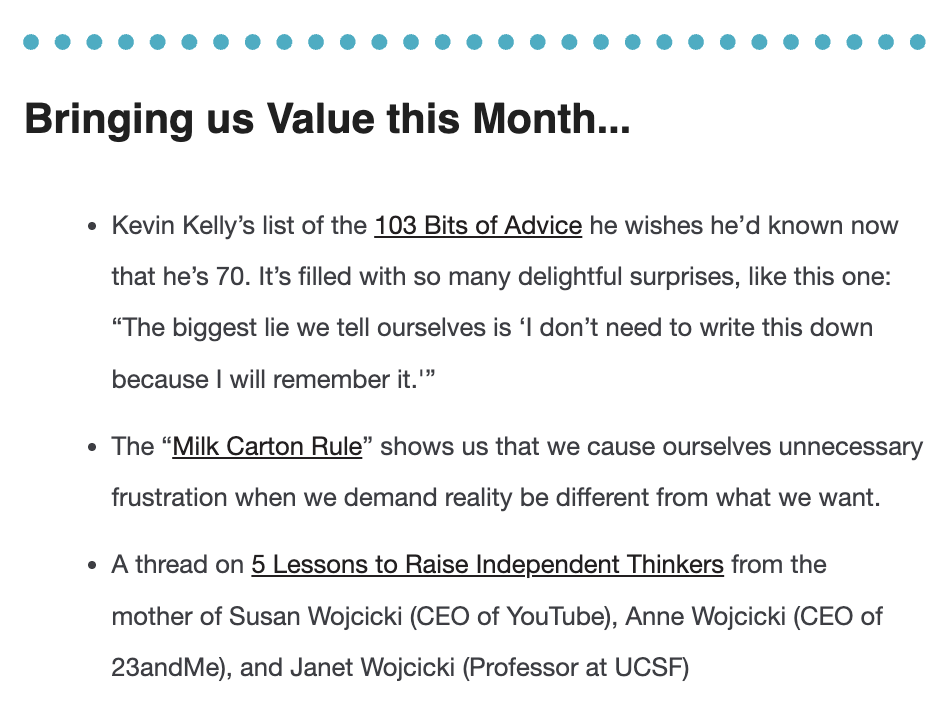
We don’t know what we don’t know, so when we explore others’ work and consider our connection to it, our own view is expanded. And when our own view is expanded, we can be more valuable to others.
Pro Tip: The content curation process isn’t dissimilar to how we scan media to find and move on opportunities. Learn more about our media scan process here.
When you monitor and share consistently, you also learn more about your audience’s preferences. This article about making thinking visible was our most clicked Creative Inspiration piece in our newsletter in 2025.
Here’s how we promoted it to our readers and got them to click through: “It leads with an educator’s POV, but it got us thinking that where we really need to focus our L&D is in the critical thinking skills that will separate humans from machines.”
What does that tell us about our newsletter audience? It tells us that they’re concerned about how AI might devalue the work humans do every day. It tells us they’re on the hunt for creative and practical solutions to work with AI instead of against it.
We infused that intel into our upcoming content. For example, we followed with two newsletter topics – Human vs Machine and Drowning in AI Sameness – that became two of the three top newsletters of 2025. We also published an article about how PR pros can work with AI to do their jobs better, instead of against it.
Collecting audience insights like this is one of the benefits of content curation. Those insights help us become better curators and come in handy when we’re mapping topics of interest on our content calendar, like our blog. The more you know your audience, the better you can curate, create, and connect with them.
Shameless Plug: Sign up for our newsletter. You’ll receive sustainable PR tips and creative inspiration. It takes five minutes to read every month and less than one minute to sign up.

Other benefits of content curation include:
Positioning and boosting your brand or executive as a thought leader. For example, sharing another expert’s insights with a distinct POV.
Diversifying your content calendar. For example, working someone else’s published content into your social feed.
Fitting your brand POV into trending conversations and news. For example, using a viral pop culture moment to draw attention to your brand’s unique mission or expertise.
With the right process (we’ve got you covered here), curation is efficient and quick. A content curator is always in “spotting” mode. You can train yourself to effectively search, find, catalog, and apply cool information your audience would love to know about (and love you even more for sharing!).
Now let’s dive into how to curate content. It’s easier than you think.
The Ins and Outs of our Content Curation Process
Consider Your Audience
Before you go poking around the vast corners of the internet for random content, there’s one thing you have to think about first: your audience.
WHO is your audience: Are they finance leaders, healthcare professionals, fitness influencers, travel gurus? Are they just starting in their careers or seasoned experts? When we onboard a new executive communications client, we nail down the WHO by asking them, “Who do you want to be a hero to, and for what?” This helps us identify exactly who they want to reach and the messages they want to communicate.
WHY they do what they do: Think about what your audience cares about and why. What are their end goals and problems they’re trying to solve? In every first interview with an executive, we ask them questions about their audience’s biggest points of friction and the reasons they might say “no” to their offering. Those answers tell us what makes their target audience “tick,” and come in handy when figuring out what content to look out for.
WHERE do they go for information: You’ve identified their struggles, goals, and aspirations. Now, what do they consume to learn and do their jobs better? We like to ask new executive clients who their favorite thought leaders are and what they like to read or listen to often. Are they Forbes frequenters? Maybe they prefer one of the Morning Brew publications. Or, a handful of niche independent journalists or influencers with highly-engaged followers.
Documenting these answers will serve you well when figuring out what to monitor and if a piece of content is ripe for curation. It’ll also help you identify your niche. For Carve, our ideal audience is in-house marketing and comms professionals and executives looking to grow their brands through communications strategies. Our curation niche is creative inspiration for that audience.
Get Organized
Now comes the method in the midst of my madness. My content curation process is a scrapbook of sorts, so here are some helpful tidbits from those pages.
Follow other industry thought leaders and look at who they follow.
Study people similar to who you are or want to be online. What are they reading and sharing? Who do they source?
But don’t just look at what they’re posting, study their methods. How do they insert their POV into the conversation? Do they have a unique method? If the topic is a little “out there,” how do they bridge the divide? How do others engage?
Billy Oppenheimer does a great job at blending his POV with curated content, like this interview with Jerry Seinfeld that teaches a deeper lesson about how to do great work:
Pro Tip:In Josh Spector’s course on content curation, he recommends following journalists, rather than publications (and subscribing to their newsletters, too). Journalists have topics and niches they stick to, whereas publications cover a wider variety than you might need.
Automate what you can.
One reason I love signing up for newsletters and Google Alerts is that I can set it, forget it, and let timely content come to me. And then, in my hour of need, I can just search through my inbox to see if it snagged anything good.
Similar to a Google Alert, there are tools that will find and email interesting articles to you from across the Internet. One of those is Refind, and it has served me well over the years.
AI might not be the greatest at pulling real-time content (yet), but it can help you identify sources to keep an eye on. Remember all that intelligence you gathered on your audience earlier? Input that into an LLM and ask it to recommend relevant publications and thought leaders. I find that it’s best to already have a great example of one and ask the LLM for “more like this.”
I recommend setting up alerts for niche topics. To figure out what these might be, refer back to the three basics of your audience.
Keep your go-to content sources on hand.
It might be a bit old-fashioned, but keeping a list is great for when you need to go out and search for content, especially if generic searches or the newsletters and feeds you follow aren’t turning up anything great. Whether in a note document or via browser bookmarks, keep a list of websites that never let you down.
Here are a few of my favorites:
Fortune and Inc, basic but still my go-tos.
Rest of World, for a global perspective.
Liz Fosslien, for her illustrations.
Big Think, for its unique library of opinions and topics.
Streamline where you keep things.
Back to my scrapbook analogy. The best part about a scrapbook is that all your most beloved pictures are stored in just one book; you’re not having to search high and low in ten different places to find what you need.
The same goes for your content curation process — keep your sources in as few places as possible.
Some people like to keep their findings in a centralized notes app. After struggling to keep my work emails separate from my incoming creative inspiration, I created a separate email address and inbox labeled “Carve Social Inspiration” to subscribe to newsletters. It keeps things a little more accessible – and less frustrating – on my end. All I have to do is search the inbox for keywords when I’m on the hunt for a particular topic.
I also keep fodder in my browser bookmarks and a folder on my desktop (my primary storage source). Whenever I come across something I like, I make sure to screenshot right then and there and store it in a folder on my computer.

So now that we’ve covered how to find and catalog content, let’s talk about what to do when you think you’ve got a hit.
Evaluating if the Content Works for You
Not everything you find is going to work for your audience. Or, as Josh Spector phrases it: “just because it’s interesting doesn’t mean it’s right.”
Here is a litmus test to see if a piece of content is share-worthy:
✅ Revisit those audience questions you answered and put yourself in their shoes. Can you connect this to the why that makes your audience “tick?” Does this help them solve a problem they struggle with? Is this something your audience would save for future reference, like this chart from Pragmatic Engineer covering all the reasons developers dislike tools. It was a good find to engage our CTO client’s developer/technical audience.
✅ Why would the reader find this piece valuable? Can the reader take the information and do something with it? Maybe the piece is simply fun, novel, or inspiring. The most important thing is that your reader will find something of value. Otherwise, move on. We shared this post from a journalist commenting on the paradox of mornings because we thought it was fun for our LinkedIn audience, and we could draw a connection to PR:
✅ Is there a way to put your own spin and POV on it? The connection between the piece of content and your POV shouldn’t feel like a “reach.” If it does, it won’t feel authentic. This article about the construction labor shortage offered an opportunity for a construction tech CEO to both comment on the industry trend and highlight how we can fix the inefficiencies contributing to the shortage.
Pro Tip: I love Delia Cai’s advice, author of a curated pop culture newsletter, about knowing when something should be shared or not. She keeps it simple: “The clearest sign that something is worth linking to is when I find myself automatically texting it to friends and wanting to burn up the whole morning talking about it; that’s when I know I have Thoughts and Feelings (and that likely, others will too).”
Again, not everything that’s interesting or excites you is necessarily a good fit for your audience. But if your piece passed the litmus test, congratulations! You’ve successfully navigated through the content curation process — it’s time to share the knowledge.
If figuring out how to curate content seems daunting at first, stick with it. You’ll get the hang of it and figure out what works best for you. This is just a glimpse into one creative’s experience. The important thing is just that you share with the world. We could all use a different perspective here and there.